
Single Tooth Implants in Bingham Farms
A single missing tooth affects more than your smile. It affects your bite, your bone, and the teeth around it. At Groth Dental, we restore single missing teeth with implant-supported crowns that look, feel, and function like the real thing.
Why Single
Tooth Implants
When a tooth is lost, replacing it with an implant-supported crown is one of the most effective and long-lasting solutions available. Unlike a traditional bridge, a single implant does not require any alteration to the neighboring teeth, preserving what you already have while restoring what was lost.
Benefits of single tooth implants include:
A natural appearance that blends seamlessly with your surrounding teeth
Durable, reliable chewing function restored to full capacity
A permanently fixed restoration that does not shift or move
Stimulation of the jawbone to significantly reduce bone loss after extraction
No impact on neighboring teeth
How a Single Tooth Implant Works
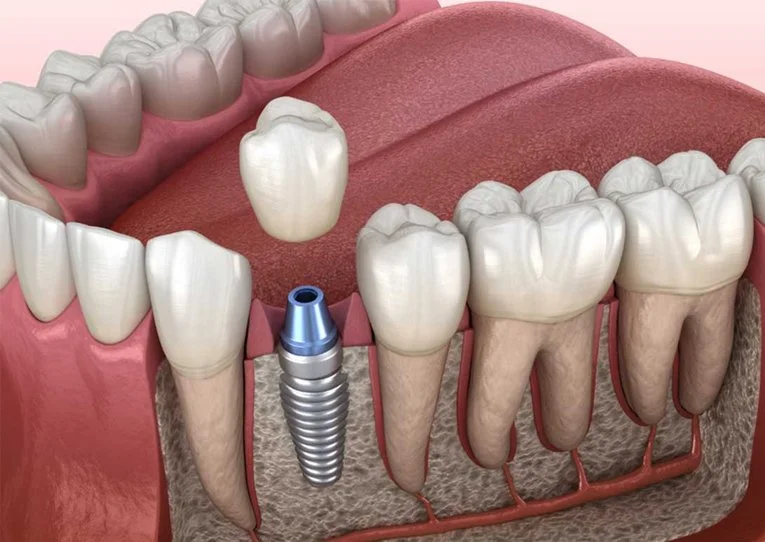
A dental implant is a titanium post that is surgically placed into the jawbone to serve as an artificial tooth root. It is made up of three components that work together to create a complete, natural-looking restoration:
The implant post, also called the body, is positioned within the jawbone and serves as the stable anchor for the entire restoration
The abutment connects the implant post to the crown above the gumline
The crown is the visible portion of the tooth, custom-crafted to match the shape and shade of your natural teeth. In some cases, the crown may be part of a bridge supported by multiple implants
Common Questions About Single Tooth Implants
-
Not necessarily. The right treatment plan depends on your individual situation, including how many teeth are missing and the condition of your jawbone. Dr. Groth will evaluate your case during a consultation and recommend the most appropriate solution.
-
We do not place temporary crowns or bridges on newly placed implants. Keeping pressure off the implant during the initial healing period is essential to allow it to properly fuse with the jawbone and ensure long-term stability.
-
Most patients are candidates, including many who have been told in the past that they were not eligible. The best way to find out is to schedule a consultation so Dr. Groth can evaluate your bone structure and overall oral health.
-
Care for your implant the same way you care for your natural teeth. Brush and floss twice daily and keep up with regular professional cleanings at the intervals Dr. Groth recommends.
-
Implant-supported crowns are custom-made to match the shape, size, and shade of your surrounding teeth. The implant post itself sits beneath the gumline and is completely hidden. Most people will not be able to tell the difference between an implant crown and a natural tooth.
-
It will function in the same way as a natural tooth. Most patients adapt quickly and find that eating, speaking, and smiling feel completely normal with their restoration in place.
-
Most patients return to work within one to two days. Some may prefer a bit more time depending on how they feel during recovery. Dr. Groth will give you specific guidance based on your procedure.
-
The implant post is placed into the jawbone and allowed to integrate for four to six months. Impressions are then taken and sent to our lab to fabricate the custom abutment and crown. If bone grafting is needed beforehand, this may extend the overall timeline.
-
Once a dental implant has fully integrated with the jawbone and the restoration is complete, it is a permanent fixture and cannot be removed.
-
We offer oral conscious sedation, which is prescribed in advance and picked up at your pharmacy before your appointment. It helps you feel relaxed during the procedure and often results in little to no memory of it. A designated driver is required, as you cannot drive or operate machinery after taking the medication.
-
Some bleeding for up to 24 hours after implant placement is normal. If bleeding is heavy or does not subside, contact our office. A helpful home remedy is placing a dampened tea bag on the site, as the tannic acid helps promote clotting.
-
Some discomfort and swelling are expected and normal. Many patients find it manageable and return to their routine quickly. Pain medication will be prescribed to keep you comfortable during recovery.
-
We do not currently offer zirconia implants. Because they are relatively new with limited long-term data, we use titanium implants exclusively for their proven and highly predictable outcomes.
-
Titanium implants have a success rate of over 95 percent. Failure is uncommon but can occur due to factors such as poor bone integration, smoking, or uncontrolled diabetes. If an implant fails within the first year, it is typically replaced at no additional cost.
Dental Implant Timeline
1
The implant post is placed into the jawbone and allowed to fuse with the surrounding bone. This integration period takes approximately four months and is essential for the long-term stability of your restoration.
2
The implants are uncovered and the gum tissue is given two weeks to naturally contour and shape itself around the implant site.
3
Impressions are taken and sent to our dental lab for fabrication of the custom abutment and crown. Lab turnaround typically takes three to four weeks.
4
The abutment and crown are placed, completing your restoration with a natural-looking, fully functional tooth.
New Patients & Emergency
Appointments Welcome!
We’re Your Top-Rated Team
PROUDLY SERVING THE BINGHAM FARMS AREA